September 11, 2026



If you are a farmer or rancher who needs to store hay, one of the first big decisions you’ll face is choosing the right structure. A metal hay barn, sometimes called a hay storage building, is one of the most practical and durable choices available. Metal barns are tough, low-maintenance, and built to last for decades.
But here’s where it gets interesting: not all metal hay barns are the same. There are two main types: open barns and enclosed barns, each with its own set of advantages and trade-offs.
The core challenge most farmers face is balancing three things: moisture control, ventilation, and weather protection. Get that balance wrong, and you could end up with moldy, spoiled hay, which is a costly mistake.
Just imagine, if a farmer in Kansas stored 200 bales in a simple open barn, only to lose a third of his stock after an unexpected rainy season. Or a rancher in Arizona who spent thousands on a fully enclosed barn and didn’t really need it for a dry climate. Both situations were avoidable with the right information.
Let’s compare both options to help you choose the right hay storage barn design.
Also Read: Why Choose a Metal Red Barn?
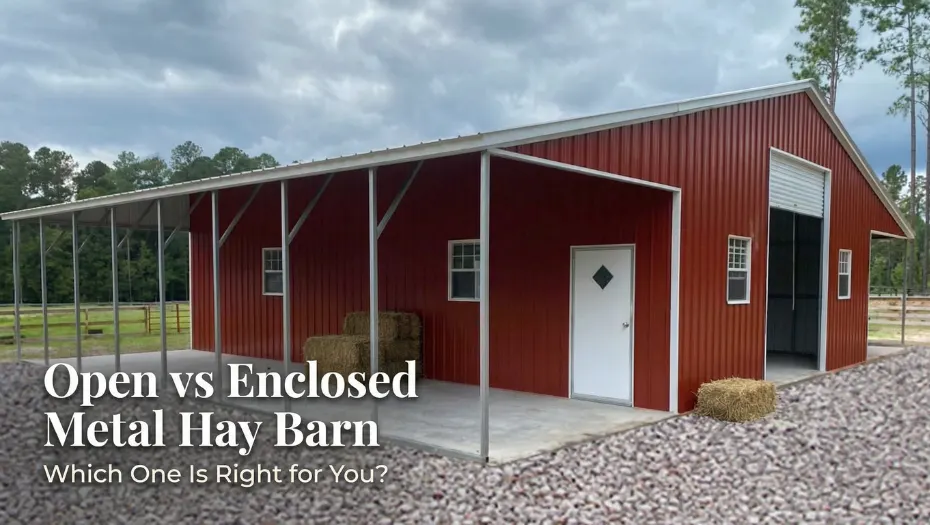
An open metal hay barn is exactly what it sounds like: a steel-framed structure with a solid roof but open or partially open sides. Think of it as a large, permanent canopy built specifically to protect hay from rain and direct sunlight while keeping air moving freely around your bales.+
Structurally, open barns typically consist of a galvanized steel hay barn frame with a peaked or gable roof, vertical support posts, and no solid walls, or just partial walls on one or two sides for added wind protection. The open design means there are no doors or sealed panels to worry about.
Common use cases for open metal hay barns include:
For example, a cattle ranch in West Texas might use an open steel hay barn to store thousands of round bales through the summer. The open sides ensure constant airflow, which prevents heat build-up and keeps hay quality intact throughout the dry season.
Curious how an enclosed barn compares? Let’s look at what that setup offers; the differences might surprise you.
An enclosed metal hay barn is a fully sealed steel hay storage building with solid walls, insulated panels, roll-up or sliding doors, and built-in ventilation systems. Unlike open barns, every element of an enclosed barn is designed to keep outside weather, rain, snow, humidity, and extreme temperatures away from your stored hay.
Enclosed barns usually feature ridge vents, exhaust fans, or adjustable louvers to regulate airflow inside. The ventilation isn’t left to chance; you control it.
These structures are most commonly used for:
Consider a dairy farm in Wisconsin that needs to store alfalfa hay through a harsh winter. An enclosed steel hay storage building with proper ventilation and insulation keeps the hay dry and nutritious, even when there’s three feet of snow outside. You might also be interested in our metal barn with living quarters for operations that need both hay storage and on-site accommodation.
Now that you know what each type is, let’s get into the head-to-head comparison. The details in the next section will make your decision much easier.
Here’s a side-by-side breakdown of how open and enclosed steel hay barns stack up across the factors that matter most:
|
Feature |
Open Metal Hay Barn | Enclosed Metal Hay Barn |
|
Cost |
Lower upfront | Higher upfront |
|
Ventilation |
Excellent (natural airflow) | Controlled (vents/fans) |
|
Weather Protection |
Moderate |
High |
| Moisture Control | Low |
High |
| Maintenance | Low |
Medium |
| Best For | Dry / arid climates |
Humid / rainy / snowy areas |
As you can see, neither option is universally better; each shines in different conditions. Your climate, budget, and how long you plan to store hay are the real deciding factors. Speaking of climate, that’s exactly what we’ll look at next.
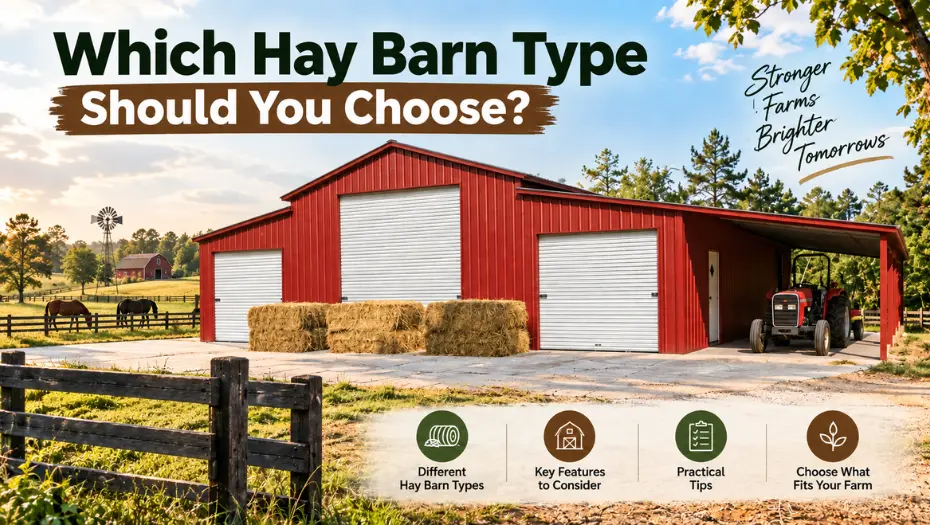
You Might Like: Which Hay Barn Type Should You Choose? A Practical Guide
If you’re farming in a dry, arid climate, like Texas, New Mexico, or Arizona, an open metal hay barn is often the smarter pick. The constant natural airflow prevents heat build-up inside the barn, and since humidity is low, moisture isn’t a serious threat to your hay quality.
Many ranchers across the Southwest have been using open steel barns for decades, and they swear by them for their simplicity and low running costs. Carolina metal barn designs are a popular open-barn option that’s proven to hold up well in hot, dry conditions.
For farmers in the Southeast, the Gulf Coast, or the Pacific Northwest, where rainfall is heavy and humidity stays high, an enclosed hay barn is strongly recommended. Open barns in these regions leave hay vulnerable to moisture absorption, which leads to mold, spoilage, and potential fire hazards from spontaneous combustion.
Enclosed steel hay storage buildings with controlled ventilation give you a fighting chance against the elements in these wetter climates.
In the Midwest, the Rockies, or the Northeast, snow load is a serious structural concern. An enclosed barn with a vertical roof design is preferred; the steep pitch allows snow to slide off instead of accumulating and adding dangerous weight. If you’re in a snow-heavy zone, always check local building codes and choose a barn rated for your area’s snow load requirements.
Our raise centre barn designs are engineered for exactly these kinds of high-load environments. Now let’s talk numbers, because the cost difference between the two types might be bigger (or smaller) than you expect.
Cost is often the tipping point for most buyers, so let’s break it down in plain terms. Keep in mind these are general estimates; actual hay storage building cost varies significantly based on your location and supplier.
Several key factors affect the final price for either type:
From a long-term perspective, an open barn is cheaper to build and maintain but may cost you more in spoiled hay losses if you’re in a wetter climate. An enclosed barn is a bigger initial investment, but it can pay for itself by protecting high-value hay over multiple seasons. Check out our guide to choose the best metal structure for a deeper look at how to calculate long-term value.
So, what are the most popular designs being built today? That’s exactly what we’ll explore next.
Popular Hay Storage Barn Designs
Whether you go open or enclosed, there’s no shortage of hay storage barn designs to choose from. Here are the most common layouts farmers are using today:
Before you settle on a design, there are a few important factors worth thinking through. Let’s walk through them.
Even with the best planning, there are a few common mistakes that trip up first-time buyers. Here’s what to watch out for.
Read More: Metal Hay Barn to Protect Your Haystacks and Other Agricultural Things
The best barn depends on your climate and storage needs. An open metal hay barn works well in dry regions due to superior airflow. An enclosed steel hay barn is better for humid, rainy, or snowy areas where moisture and weather protection are priorities.
Metal barns significantly reduce mold risk when properly ventilated. Enclosed barns with ridge vents or fans offer the best mold prevention. Open barns help too, but they’re less effective in high-humidity climates where damp air can still reach the hay.
Hay should never be stored in a completely sealed, airless space. Experts recommend consistent airflow to allow heat and moisture to escape during the curing process. Enclosed barns should have at least one vent per 150–200 square feet of floor space.
For farmers in humid or wet climates, storing high-value hay like alfalfa, yes — enclosed barns are absolutely worth the investment. The protection they offer can prevent thousands of dollars in annual hay losses, making the higher upfront cost pay for itself over time.
A standard 1,000 square feet of barn space can store roughly 150–200 round bales. For square bales, the count will be higher depending on the stacking height. Always add extra capacity for seasonal inventory spikes and future herd growth.
Yes! One of the advantages of steel hay barn construction is modular flexibility. Many open barns can be partially or fully enclosed later by adding wall panels, doors, and ventilation systems — a smart approach if you’re budget-conscious today but want options tomorrow.
A well-built steel hay storage building can last 40–60 years or more with minimal maintenance. Galvanized or Galvalume-coated steel panels are especially resistant to rust and corrosion, making them a smart long-term investment for any farming operation.
Choosing between an open and enclosed metal hay barn doesn’t have to be complicated. Know your climate, set a realistic budget, and think about how long and how much hay you need to store. Those three factors will point you in the right direction almost every time. Whether you go with a breezy open lean-to or a fully sealed hay storage barn, the most important thing is that your hay stays dry, well-ventilated, and protected throughout the storage period.