September 11, 2026



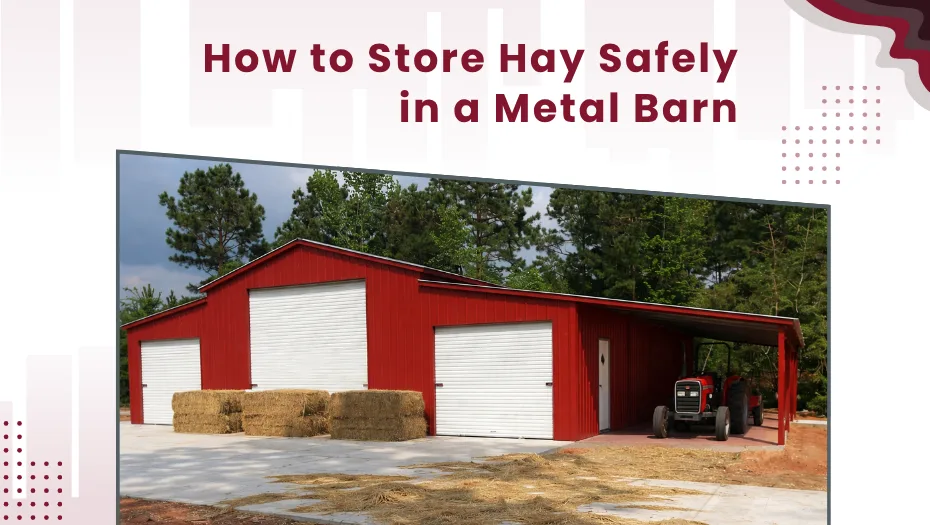
Hay is one of the most valuable commodities on any farm, and one of the most vulnerable. Improper storage can trigger rapid mold growth, cause serious nutritional loss, and in extreme cases, lead to spontaneous combustion from the heat generated by fermenting wet bales. Protecting your harvest begins with choosing the right structure.
A well-designed metal hay barn has become the go-to choice for farmers and ranchers across the country. Unlike wood structures, steel is non-porous, resistant to rot, and can be engineered specifically for airflow and moisture control. Whether you are building your first hay storage building or upgrading an aging structure, understanding how to store hay safely is critical to protecting both your investment and your livestock.
This guide walks you through everything you need to know, from ideal moisture levels and ventilation strategies to flooring choices and common mistakes to avoid.
Follow these core principles to protect your hay from the moment it enters your barn:
Moisture is the single greatest threat to stored hay. Understanding the risks helps you make smarter decisions about your hay storage barn and the practices you follow inside it.
When hay moisture exceeds 18%, mold spores activate rapidly. Moldy hay loses palatability and can cause serious respiratory issues in livestock. According to university extension studies, up to 30% of a hay bale’s dry matter can be lost to mold under poor storage conditions.
Even without visible mold, excess moisture triggers microbial activity that degrades protein and energy content. A bale stored at 20% moisture can lose 20–40% of its nutritional value within the first 60 days, a costly outcome for any operation.
Wet hay stored in a confined space generates internal heat as bacteria break down plant material. If core temperatures inside bale stacks exceed 170°F (77°C), spontaneous combustion becomes a real and documented danger. The National Fire Protection Association has cited hay storage fires as a leading cause of agricultural barn losses. A properly designed metal barn with adequate ventilation dramatically reduces this risk.
Replacing spoiled hay mid-winter, when prices peak, is expensive. Farmers can pay 30–60% more per ton during seasonal shortages. Investing in a quality hay storage barn pays for itself quickly by eliminating these losses.
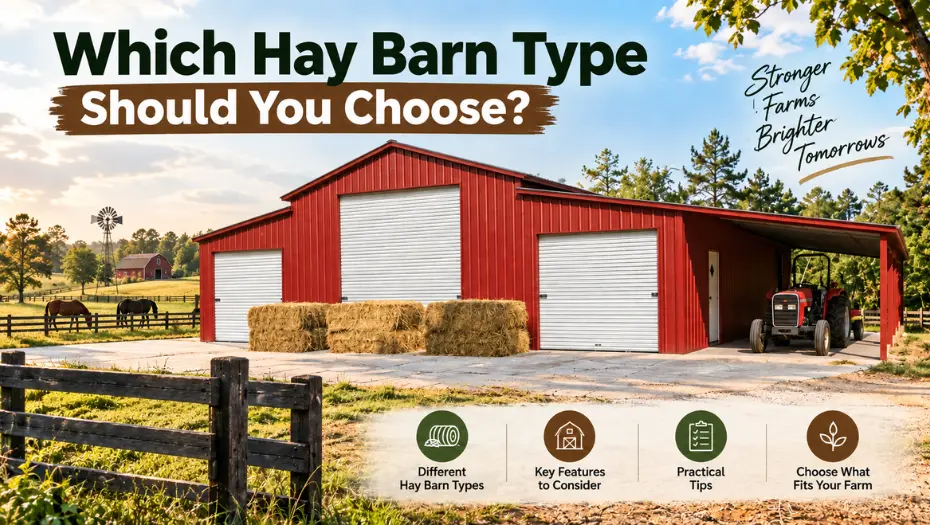
Not all barn designs are equal when it comes to hay storage. Exploring the different types of hay barns helps you match structure to climate and herd size. The three most common configurations each offer distinct advantages.
Open-sided designs feature a full roof with one or more open walls, allowing maximum cross-ventilation. These are ideal in dry climates where rainfall is predictable and infrequent. Hay benefits from constant airflow, which keeps moisture from building up around and within bales. The trade-off is exposure to wind-driven rain, so site orientation matters; orient the open side away from prevailing weather.
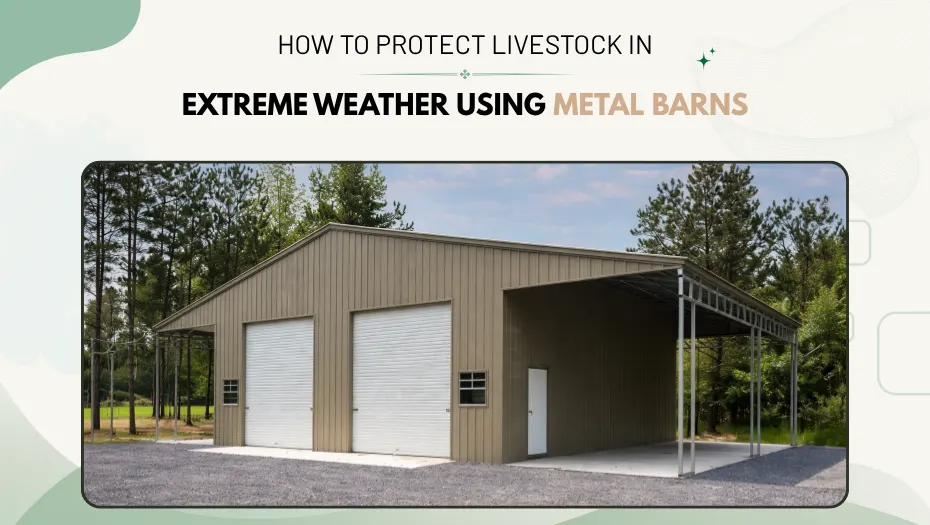
A fully enclosed steel hay barn provides complete protection from rain, snow, and wind, making it the preferred choice in humid or high-rainfall regions. Because airflow is restricted, these buildings require an intentional ventilation system: ridge vents, gable fans, or louvered side panels. Without these, condensation on the steel panels can drip onto stored bales. Properly insulated and vented, an enclosed steel barn remains the most protective option for year-round storage.
If you are building an enclosed structure, consider exploring woven R-17 insulation for metal barn applications. This product significantly reduces the temperature differential between panel surfaces and interior air, cutting condensation by controlling heat transfer through the roof and walls.
Vertical roof steel barns are widely considered the gold standard for hay storage barn designs. The vertical orientation of the roof panels allows rain and debris to slide off cleanly, preventing water pooling at panel seams. The result is a tighter, drier structure that outperforms horizontal roof panels in wet climates. Vertical roof designs also tend to carry higher wind and snow load ratings, an important consideration when storing heavy quantities of hay.
Moisture content is the single most measurable indicator of whether hay is safe to store. Always test with a calibrated hay moisture meter before loading bales into your metal hay barn.
Round bales tolerate slightly lower storage moisture than square bales due to their density. For large round bales, target 14% or below before placing them in enclosed storage. Square bales can be stored up to 15% with good airflow. When in doubt, test multiple bales in a load; moisture can vary significantly within a single cutting.
Condensation is a common and overlooked problem in steel hay storage buildings. Metal panels conduct temperature changes rapidly — on cool nights, warm humid air inside the barn condenses on cold panel surfaces and drips down onto stored hay. The fix is a combination of smart design and management.
A continuous ridge vent running the full length of the roofline allows hot, moist air to escape naturally through convection. This is the single most effective passive ventilation feature in any hay storage building.
Low side vents near the base of the walls bring cooler, drier outside air into the building. Paired with ridge vents, this creates a natural stack effect, fresh air in at the bottom, moisture-laden air out at the top. Louvered panels at gable ends enhance this effect dramatically.
Leaving eaves partially open, typically 4 to 6 inches, on non-weather sides of the barn allows continuous air movement without exposing the interior to direct precipitation. Many prefabricated steel hay storage buildings can be ordered with open-eave options.
The most effective setups combine all of the above with strategic placement: align the barn’s long axis perpendicular to prevailing winds. This maximizes natural cross-ventilation and keeps interior temperatures stable, reducing the temperature swings that cause condensation to form on panel surfaces.
Ground moisture is often the first source of hay spoilage, and the most easily overlooked. Never store bales in direct contact with bare soil or unsealed floors. Here are the three most common flooring solutions for a hay storage barn:
Poured concrete provides a durable, cleanable surface that resists moisture intrusion when properly sealed. A 4-inch slab with a 6-mil vapor barrier beneath is standard for hay storage applications. The main downside is cost, particularly for large building footprints. However, concrete greatly simplifies cleanup and eliminates the ground moisture variable entirely.
A 4- to 6-inch compacted gravel base is a more economical option that provides drainage and keeps bales off the soil. Use crushed stone rather than pea gravel — the angular edges compact tightly and resist shifting under load. Gravel bases are less effective in areas with high water tables or frequent flooding.
Wooden pallets are the most widely recommended option for hay storage. They elevate bales 4 to 6 inches off the floor, creating a critical air gap beneath each stack. This airflow dries the underside of bales and prevents moisture from wicking through ground contact. Pallets are inexpensive, movable, and easily replaced. For best results, place pallets on concrete or a compacted gravel base and space stacks to allow airflow between rows.
How you arrange bales inside your metal barn is just as important as the building itself. Poor stacking leads to instability, restricted airflow, and moisture buildup inside stacks.
Even a well-built steel hay barn cannot compensate for poor storage habits. These are the most common and costly mistakes to avoid:
One often-overlooked category of problem relates to barn sizing. Many first-time builders underestimate how much space hay actually requires. This parallels the kind of single car garage size mistakes that lead homeowners to discover their car barely fits, only here, the consequences are a lost crop rather than a scratched door. Always calculate your bale count and add 20% buffer for operational clearance.
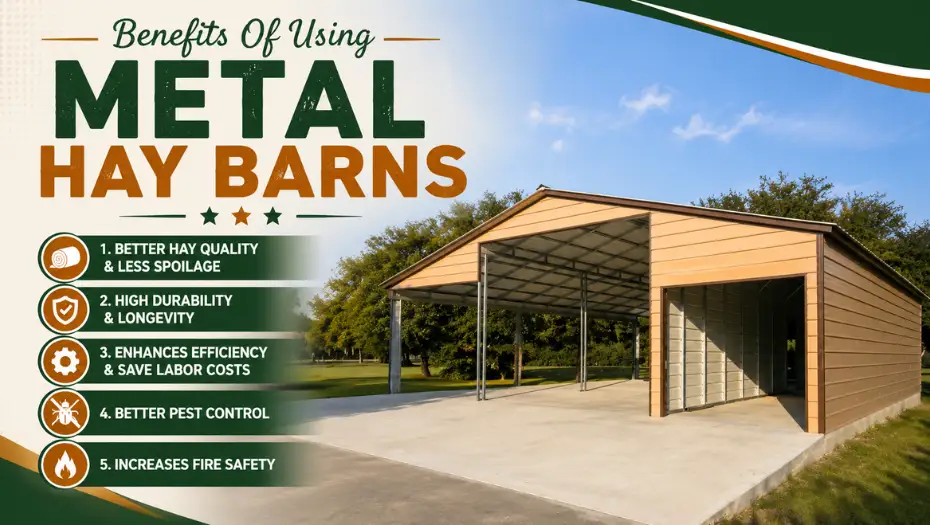
The short answer is yes, in virtually every measurable category, a modern steel barn outperforms a traditional wooden barn for hay storage. Here is a direct comparison:
|
Feature |
Metal / Steel Barn | Traditional Wood Barn | Winner |
|
Moisture Resistance |
Excellent – non-porous panels | Poor – absorbs moisture | Metal Barn |
|
Maintenance |
Minimal – rust-proof coating | High – painting, repairs | Metal Barn |
| Initial Cost | Lower (prefab options) | Higher (custom build) |
Metal Barn |
| Durability | 50+ years with basic care | 25–35 years avg. |
Metal Barn |
| Fire Risk | Steel is non-combustible | High combustibility |
Metal Barn |
Wood absorbs and releases moisture continuously, making it difficult to maintain stable interior humidity. Steel panels, when properly vented and optionally insulated, create a much more controllable interior environment. The initial cost advantage of a prefabricated steel barn also closes the gap quickly when you factor in the elimination of ongoing wood maintenance and the avoided losses from hay spoilage.
A quality hay storage building built from steel also carries better resale value and typically qualifies for longer depreciation schedules under agricultural tax treatment than wood structures.
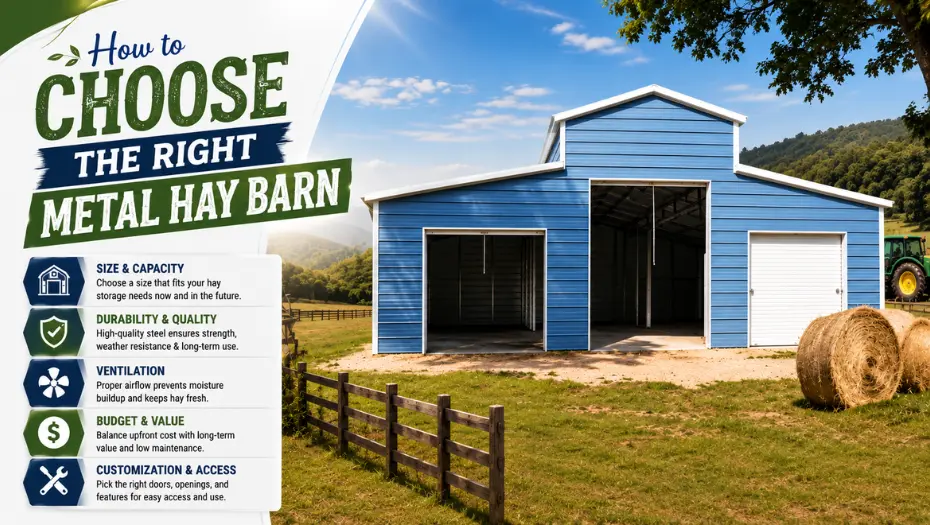
Choosing the right structure involves more than picking a size. Work through these four considerations before placing an order or breaking ground:
Calculate your total annual hay production or purchase volume. A 4-foot-by-4-foot-by-8-foot square bale occupies roughly 128 cubic feet; a large round bale (5 ft × 6 ft) occupies approximately 118 cubic feet. Divide your total cubic footage by your intended stack height to determine the floor area required. Add 20–30% for aisles, operational clearance, and growth.
Vertical roof panels are the top recommendation for hay storage in any climate with regular rainfall or snow. Horizontal (regular) and A-frame styles are more economical but less effective at shedding water at panel seams. If budget is the constraint, at a minimum, select an A-frame style over a regular roof.
Determine whether your climate and hay volume require passive or active ventilation. Passive systems (ridge and side vents, open eaves) handle most hay storage scenarios well. In high-humidity regions or very large enclosed buildings, active systems with powered fans provide greater control. Build the ventilation system into the barn design from the start; retrofitting is expensive.
Wind direction, average rainfall, snow load requirements, and seasonal temperature swings all affect the specifications you need. In northern states, snow load ratings must meet local building codes, typically 20–40 psf. In coastal or high-humidity regions, opt for galvalume panels over standard galvanized for enhanced corrosion resistance. Always check local agricultural zoning and permitting requirements before ordering a prefabricated metal barn.
Storing hay safely in a metal barn is not complicated, but it does demand attention to a handful of fundamentals: moisture content, ventilation, flooring, and smart stacking practices. A well-chosen steel hay barn provides the structural foundation, non-porous panels, durable framing, and design flexibility, but what happens inside the building determines whether your hay makes it to spring in peak condition.
Start by testing every load before it enters storage. Invest in a ventilation system that matches your climate and building size. Elevate bales off the floor. Leave airflow gaps around every stack. And choose a vertical roof design if you are building or upgrading; it is the single most impactful structural choice you can make for long-term hay quality.
The farmers who lose the least hay to spoilage are not necessarily the ones with the biggest or most expensive buildings. They are the ones who understand why moisture is the enemy and who design their entire storage system around defeating it.
Yes. The fire risk comes from the hay itself, not the barn. Wet hay stored above 18% moisture generates internal heat through microbial activity. If bale core temperatures reach 170°F or higher, spontaneous combustion can occur. A metal barn reduces external ignition risks since steel is non-combustible, but monitoring hay moisture and ventilation remains essential.
A fully enclosed vertical roof steel barn with ridge vents, side vents, and open eaves offers the best overall protection. The vertical roof sheds water cleanly, the ventilation system prevents condensation, and the enclosed structure keeps rain and snow off bales in all weather conditions. This design works well in nearly every North American climate.
Metal panels can promote condensation when warm, humid interior air contacts cold steel surfaces. This is preventable with proper ventilation, ridge vents, side vents, and open eaves, and optionally with insulation on roof panels. A well-designed steel hay storage building with adequate airflow manages condensation effectively and keeps stored hay dry.
In high-humidity regions, use a fully enclosed steel barn with an active ventilation system, insulated roof panels, and wooden pallets to elevate bales off the floor. Test hay moisture before storage and only store bales below 15%. Inspect regularly during the first two weeks after storage, when internal bale temperatures are highest, and moisture migration is most active.
It depends on the bale type and stack height. A 40×60-foot metal hay barn (2,400 sq ft of floor space) can typically hold 400–600 large round bales stacked two high, or 1,000–1,500 small square bales stacked four bales high with proper aisle clearance. Always account for at least 20% of floor space for aisles and handling room.
A dedicated hay moisture meter, rather than a wood or grain meter, provides the most accurate readings. Insert probes into the core of multiple bales from a load, not just the surface. Surface readings can be 3–5 percentage points lower than core readings. Target an average reading of 15% or below before moving bales into enclosed storage.
Inspect newly stored hay every two to three days for the first two weeks; this is when internal temperatures peak and problems are most likely to develop. After that, a weekly walkthrough is sufficient. Check for musty odors, visible mold, unusual heat, wet spots on the floor beneath stacks, or condensation dripping from roof panels.
Insulation is highly beneficial in climates with large seasonal temperature swings or high humidity. It reduces the temperature differential between panel surfaces and interior air, cutting condensation significantly. For many operations, Woven R-17 insulation for metal barn applications offers a practical balance of thermal resistance, cost, and ease of installation without adding excessive bulk to the structure.