Loading...
A metal horse barn is one of the most valuable investments for protecting your horses, equipment, feed, and tack. However, even the strongest steel structure depends on one critical component beneath it – the foundation.
Choosing the best foundation for a steel horse barn affects everything from structural stability and drainage to your horses’ safety and the building’s lifespan. A poorly prepared foundation can lead to uneven settling, water accumulation, cracked flooring, rust, and costly repairs, while the right foundation ensures your barn performs reliably for decades.
So, what is the best foundation for a custom horse barn?
For most permanent steel horse barns, a reinforced concrete slab is the best foundation because it provides superior strength, excellent load-bearing capacity, long-term durability, and a stable surface for horse stalls and equipment. However, compacted gravel pads, concrete piers, and perimeter foundations can also be suitable depending on your steel barn size, budget, soil conditions, and intended use.
This guide explains the most common horse barn foundation types, their pros and cons, installation considerations, estimated costs, and expert recommendations to help you choose the right foundation for your property.
Read Our Latest Blog: Steel Barn Foundation Options: Concrete vs. Gravel vs. Dirt
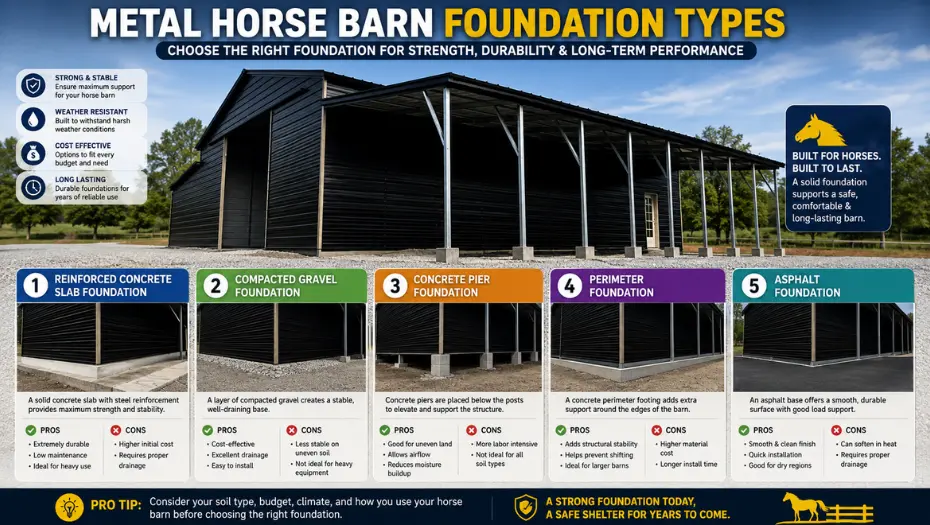
Types of Foundations for Metal Horse Barns
Several foundation options are available, each offering different benefits depending on your property and budget.
Let’s compare the most common choices.
1. Reinforced Concrete Slab Foundation
For most permanent prefabricated horse barns, a reinforced concrete slab is considered the industry standard.
The slab is poured directly onto a prepared base of compacted gravel and reinforced with steel rebar or welded wire mesh. This creates a strong, level surface capable of supporting horses, equipment, trailers, and heavy loads.
Best For
- Permanent horse barns
- Large riding barns
- Commercial equestrian facilities
- Multi-stall barns
- Workshops attached to horse barns
Advantages
- Exceptional structural strength
- Long lifespan
- Minimal maintenance
- Excellent load capacity
- Supports heavy equipment
- Cleaner interior environment
- Easier stall maintenance
- Better pest control
Limitations
- Higher upfront installation cost
- Longer construction time
- Professional installation required
2. Compacted Gravel Foundation
A compacted gravel pad is one of the most affordable foundation options for smaller prefab horse barns.
Instead of pouring concrete, crushed stone is spread, leveled, and compacted to create a stable base for the building.
Many horse owners prefer gravel because it offers excellent drainage and lower installation costs.
Best For
- Small horse shelters
- Run-in sheds
- Temporary barns
- Budget-conscious projects
- Rural agricultural properties
Advantages
- Lower installation cost
- Excellent drainage
- Faster installation
- Easier future expansion
- Reduced standing water
Limitations
- Requires periodic maintenance
- Less stable for heavy equipment
- Can shift over time
- Not ideal for very large barns
3. Concrete Pier Foundation
A concrete pier foundation uses individual reinforced concrete footings placed below the frost line to support the structural frame. Instead of supporting the entire building with a continuous slab, the load is transferred through strategically positioned piers.
This foundation works well on uneven terrain or locations where a full concrete slab isn’t practical.
Best For
- Sloped properties
- Uneven ground
- Rural farms
- Large agricultural horse barns
- Sites with challenging soil conditions
Advantages
- Less concrete required than a full slab
- Performs well on uneven terrain
- Good moisture protection
- Easier utility installation beneath the building
- Lower excavation requirements
Limitations
- Interior flooring must be installed separately
- Requires precise engineering and layout
- Not ideal for every barn design
4. Perimeter Foundation
A perimeter foundation consists of continuous concrete footings around the outer edge of the building. The interior floor can then be finished with compacted gravel, concrete, rubber mats, or other suitable materials.
This option offers excellent structural stability while allowing greater flexibility for interior flooring.
Best For
- Horse barns with multiple stalls
- Mixed-use agricultural buildings
- Equipment storage areas
- Large livestock facilities
Advantages
- Strong structural support
- Flexible interior flooring options
- Better moisture control
- Lower concrete usage than a full slab
Limitations
- More complex construction
- Requires professional engineering
- Interior flooring adds additional costs
5. Asphalt Foundation
Although less common, asphalt foundations are sometimes used for riding arenas, equipment storage buildings, or temporary agricultural structures.
They provide a smooth surface at a lower installation cost than concrete but generally require more maintenance over time.
Best For
- Equipment storage
- Seasonal barns
- Riding arena access
- Temporary agricultural structures
Advantages
- Lower installation cost
- Faster installation
- Smooth driving surface
Limitations
- Shorter lifespan
- Less resistant to heavy point loads
- Can soften in extremely hot temperatures
|
Foundation Type |
Durability | Drainage | Lifespan | Best For |
| Reinforced Concrete Slab | Excellent | Very Good | 40–60+ Years |
Permanent Horse Barns |
|
Compacted Gravel Pad |
Good | Excellent | 15–30 Years | Small & Budget Barns |
| Concrete Piers | Very Good | Excellent | 40–50+ Years |
Uneven Ground |
|
Perimeter Foundation |
Excellent | Very Good | 40–60 Years | Large Agricultural Barns |
| Asphalt | Fair | Good | 15–25 Years |
Temporary Structures |
You Might Like: 26-Gauge or 29-Gauge: Choosing the Right Gauge for Your Metal Barn Roof
Concrete vs. Gravel Foundation for Horse Barns
This is one of the most common questions horse barn buyers ask.
| Feature | Reinforced Concrete | Compacted Gravel |
|---|---|---|
| Initial Cost | Higher | Lower |
| Installation Time | Longer | Faster |
| Drainage | Good | Excellent |
| Durability | Excellent | Good |
| Heavy Equipment Support | Excellent | Moderate |
| Long-Term Maintenance | Low | Moderate |
| Permanent Barns | Excellent | Good |
| Temporary Barns | Good | Excellent |
Expert Recommendation
Choose reinforced concrete if you’re building a permanent horse barn that will house horses year-round, support heavy equipment, or serve as a long-term investment. Opt for a compacted gravel foundation if you need a cost-effective solution for a smaller shelter, run-in shed, or temporary structure with excellent natural drainage.
Which Foundation Performs Best in Different Climates?
Weather conditions directly impact your barn’s foundation. Choosing the right foundation for your region can improve longevity and reduce future maintenance.
| Climate | Recommended Foundation | Why? |
|---|---|---|
| Heavy Snow | Reinforced Concrete Slab | Handles high snow loads and freeze-thaw cycles. |
| High Wind Areas | Reinforced Concrete Slab | Provides maximum structural stability and anchoring. |
| Heavy Rainfall | Concrete with Proper Drainage | Reduces moisture buildup around the barn. |
| Flood-Prone Areas | Elevated Pier Foundation | Keeps the structure above standing water. |
| Dry Climates | Gravel or Concrete | Both perform well with minimal moisture concerns. |
| Rocky Terrain | Concrete Piers | Easier installation with reduced excavation. |
Why Choosing the Right Horse Barn Foundation Matters
Your foundation does far more than support the weight of a steel building. It directly influences your barn’s structural performance, maintenance costs, drainage efficiency, and the overall comfort and safety of your horses.
A well-designed foundation helps:
- Maintain structural stability for years.
- Prevent uneven settling and structural movement.
- Improve rainwater drainage around the barn.
- Reduce moisture buildup that can damage steel components.
- Support heavy equipment, tractors, and horse trailers.
- Increase the lifespan of your metal horse barn.
- Lower long-term maintenance and repair expenses.
Whether you’re planning a two-stall horse barn or a large commercial equestrian facility, investing in the right foundation from the start can save thousands of dollars in future repairs.
Which Foundation Is Best for Different Horse Barn Sizes?
Foundation requirements vary depending on the size and intended use of your barn. Larger structures place greater loads on the base and often require engineered support.
| Horse Barn Size | Recommended Foundation |
|---|---|
| 12×24 | Compacted Gravel or Reinforced Concrete |
| 24×24 | Reinforced Concrete |
| 24×36 | Reinforced Concrete |
| 30×40 | Reinforced Concrete |
| 36×48 | Reinforced Concrete |
| 40×60+ | Engineered Reinforced Concrete |
Choosing the right foundation based on your barn’s dimensions helps prevent uneven settling, improves structural stability, and supports future expansions or heavier equipment.
Factors That Determine the Best Foundation
There isn’t a one-size-fits-all solution for every property. The ideal foundation depends on several important factors that influence your building’s long-term performance.
1. Soil Type
The strength and stability of your soil determine how well a foundation can support the structure.
Common soil types include:
- Clay soil
- Sandy soil
- Gravel soil
- Rocky terrain
- Loamy soil
Soft or expansive clay soils often require additional site preparation before construction begins.
2. Local Climate
Weather conditions significantly impact foundation performance.
For example:
| Climate | Recommended Foundation |
|---|---|
| Heavy Snow | Reinforced Concrete Slab |
| High Wind Areas | Reinforced Concrete Slab |
| Moderate Climate | Concrete or Gravel |
| Dry Regions | Gravel or Concrete |
| Freeze-Thaw Areas | Frost-Protected Concrete Foundation |
Choosing a foundation that matches your local climate helps reduce movement, cracking, and water-related issues.
3. Barn Size
Larger horse barns place greater loads on the foundation.
Generally:
- Small barns may perform well on compacted gravel.
- Medium-sized barns often benefit from reinforced concrete.
- Large commercial horse barns usually require engineered concrete foundations.
4. Intended Use
Ask yourself:
- Will horses live inside full time?
- Is the barn primarily for hay storage?
- Will tractors or heavy equipment be stored?
- Are you installing wash bays or tack rooms?
- Will concrete flooring be installed inside stalls?
The more demanding the application, the stronger your foundation should be.
5. Drainage Requirements
Poor drainage causes many foundation problems.
Standing water can lead to:
- Muddy horse stalls
- Moisture damage
- Steel corrosion
- Foundation settlement
- Increased maintenance
Proper grading and drainage planning should always be part of foundation preparation.
Horse Barn Foundation Cost
Foundation costs vary based on location, excavation needs, reinforcement, material prices, and labor. While prices differ from project to project, understanding the relative investment can help with planning.
| Foundation Type | Relative Cost | Installation Time |
|---|---|---|
| Gravel Pad | Lowest | 1–3 Days |
| Concrete Piers | Moderate | 2–5 Days |
| Asphalt | Moderate | 2–4 Days |
| Reinforced Concrete Slab | High | 4–7 Days |
| Perimeter Foundation | High | 5–8 Days |
Tip: Investing in a stronger foundation often reduces long-term maintenance expenses and increases the overall lifespan of your metal horse barn.
How to Prepare the Ground for a Metal Horse Barn
Proper site preparation is just as important as the foundation itself. Even the strongest concrete slab can fail if the ground beneath it isn’t properly prepared.
Step 1: Evaluate the Site
Choose a location with:
- Stable soil
- Good natural drainage
- Easy access for equipment
- Minimal flood risk
Step 2: Remove Vegetation
Clear away:
- Grass
- Roots
- Trees
- Organic material
- Debris
This helps create a stable base for construction.
Step 3: Grade the Area
A properly graded site directs water away from the building and minimizes erosion.
Most professionals recommend a gentle slope away from the structure to improve drainage.
Step 4: Compact the Soil
Compaction reduces future settling and creates a firm base capable of supporting the building’s weight.
Professional compaction equipment is recommended for the best results.
Step 5: Install a Gravel Base
A compacted crushed stone layer improves:
- Drainage
- Load distribution
- Moisture control
- Foundation stability
Step 6: Pour or Install the Foundation
Once the site is prepared, install your chosen foundation according to engineering specifications and local building requirements.
Common Horse Barn Foundation Mistakes
Avoiding these common mistakes can save significant time and money over the life of your building.
1. Skipping Soil Testing
Different soil types have varying load-bearing capacities. Building without understanding soil conditions may lead to settling or structural movement.
2. Choosing the Cheapest Option Without Considering Long-Term Needs
A lower upfront cost doesn’t always provide the best long-term value. Select a foundation based on your barn’s intended use and environmental conditions.
3. Ignoring Drainage
Poor water management is one of the leading causes of foundation deterioration.
4. Building on Uncompacted Soil
Loose soil settles over time, potentially causing uneven floors, misaligned doors, and structural stress.
5. Not Following Local Building Codes
Local regulations may specify frost depth, footing dimensions, anchoring methods, and wind or snow load requirements. Always verify applicable requirements before construction.
Foundation Maintenance Tips
Routine maintenance helps maximize the lifespan of your foundation and reduces the likelihood of expensive repairs.
Annual Maintenance Checklist
- Inspect for cracks or settling.
- Remove vegetation around the foundation.
- Check gutters and downspouts.
- Ensure drainage paths remain clear.
- Repair erosion promptly.
- Replenish gravel where needed.
- Monitor for signs of standing water.
How to Choose the Best Foundation for Your Metal Horse Barn
If you’re still unsure which option is right for your project, use this quick comparison.
| Your Priority | Recommended Foundation |
|---|---|
| Maximum Strength | Reinforced Concrete Slab |
| Lowest Cost | Compacted Gravel Pad |
| Heavy Snow Areas | Reinforced Concrete Slab |
| High-Wind Regions | Reinforced Concrete Slab |
| Uneven Terrain | Concrete Piers |
| Flood-Prone Areas | Elevated Pier Foundation |
| Temporary Barn | Gravel Pad |
| Large Commercial Horse Barn | Reinforced Concrete Slab |
| Future Expansion | Perimeter Foundation |
| Minimal Maintenance | Reinforced Concrete Slab |
Final Verdict: What Is the Best Foundation for a Steel Horse Barn?
There isn’t a universal solution for every property, but for most permanent horse barns, a reinforced concrete slab remains the best overall choice. It delivers superior structural strength, excellent durability, reliable support for horses and equipment, and long-term value with minimal maintenance.
A compacted gravel foundation is an excellent alternative for smaller barns, run-in sheds, or budget-conscious projects where drainage and affordability are top priorities. For uneven terrain or flood-prone locations, concrete pier foundations can provide the stability needed while accommodating site-specific conditions.
Before making your final decision, consider your soil type, local climate, barn size, intended use, drainage requirements, and applicable building codes. Investing in the right foundation today will help protect your metal horse barn for decades to come.
Frequently Asked Questions
Expand each item below to explore a few helpful answers before moving to the next blog post.
Related articles