Loading...
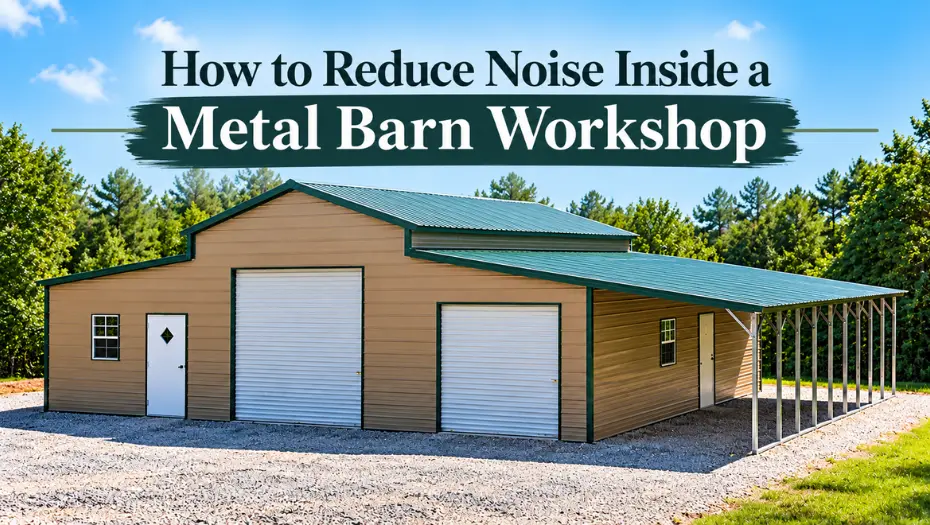
A metal barn workshop can become noisy when rain hits the roof, power tools run, machinery vibrates, or sound reflects off hard walls and floors. The most effective way to reduce noise is to identify its source and use the right combination of acoustic insulation, vibration control, sound-absorbing materials, and workshop layout improvements.
Whether you use a metal barn for automotive repairs, woodworking, farm equipment maintenance, or DIY projects, you can make the space more comfortable without assuming that one soundproofing product will solve every problem. The right approach depends on the type of noise, the building’s construction, your budget, and whether you need to reduce noise inside the workshop or prevent it from reaching nearby properties.
You Might Like: How to Create a Seasonal Maintenance Checklist for Metal Farm Buildings
Why Do Metal Barn Workshops Get Noisy?
A metal barn workshop is not automatically noisy simply because it has steel walls or a metal roof. Noise levels depend on the building assembly, interior finishes, equipment, installation, and surrounding environment.
Common sources include:
- Rain and hail: Raindrops or hail striking exposed roof panels can create noticeable impact noise.
- Power tools and machinery: Air compressors, grinders, table saws, drills, and other equipment generate airborne sound and vibration.
- Sound reflections: Bare metal walls, concrete floors, and exposed ceilings reflect sound, creating echoes.
- Vibrating equipment: Machines can transfer vibration into workbenches, floors, and structural components.
- Openings and gaps: Sound can travel through gaps around doors, windows, and other openings.
Identifying the main source helps you avoid spending money on a treatment that does not address the actual problem.
8 Ways to Reduce Noise Inside a Metal Barn Workshop
1. Install Appropriate Acoustic Insulation
Insulation can help reduce certain types of sound transmission, but its performance depends on the complete wall or roof assembly. Some insulation products are designed primarily for thermal control, while others may also contribute to acoustic performance.
If you are planning a new steel barn workshop, ask about insulation options before installation. For an existing building, check whether the proposed insulation system is compatible with the panels, framing, climate, and moisture-control requirements.
Consider these factors:
- The type and thickness of the insulation.
- Whether the roof, walls, or both need treatment.
- How joints, gaps, and penetrations will be sealed.
- Condensation control and ventilation requirements.
- Product-specific acoustic test results, where available.
Fiberglass and mineral wool are commonly used in building assemblies, but the complete system determines how well it performs. Do not assume that adding insulation alone will eliminate machinery noise or prevent all sound from leaving the building.
2. Add Sound-Absorbing Panels to Walls or Ceilings
Sound-absorbing panels can help reduce echo inside a metal barn workshop. They are especially useful when sound from tools, conversations, or machinery bounces around a large room with few soft surfaces.
Acoustic panels work by absorbing some sound energy rather than allowing it to reflect repeatedly across the room. Install suitable panels in locations where reflections are a problem, following the manufacturer’s installation and clearance requirements.
For example, a woodworking shop with a concrete floor and bare metal walls may benefit from appropriate wall or ceiling treatments around the main work area.
Keep in mind that sound absorption is not the same as soundproofing. Acoustic panels may make a workshop sound less echoey, but they will not necessarily stop loud equipment from being heard outside.
3. Isolate Machinery to Reduce Vibration
Machines can create noise by vibrating against floors, benches, or structural components. Reducing that vibration at its source can be more effective than treating the entire building.
Depending on the equipment, possible measures include:
- Installing manufacturer-approved anti-vibration mounts.
- Using suitable vibration-isolation pads beneath compressors or machinery.
- Securing workbenches so they do not rattle during operation.
- Checking loose panels, fasteners, guards, and machine components.
- Maintaining equipment according to the manufacturer’s instructions.
The isolation material must be suitable for the machine’s weight, operating speed, and movement. A soft pad that is not designed for the load may be ineffective or unsafe.
For equipment that produces significant noise, consult the manufacturer or an appropriate professional before installing an enclosure or changing its mounting arrangement.
4. Seal Gaps Around Doors and Openings
Gaps around roll-up doors, walk-in doors, windows, and service openings can allow sound to travel between the workshop and the outdoors.
Inspect the seals and replace worn or damaged weatherstripping where appropriate. Check that doors close properly and that openings are installed according to the building manufacturer’s instructions.
Sealing gaps may help with airborne sound, particularly higher-frequency noise, but it will not eliminate sound transmitted through the roof, walls, or structural frame.
Do not seal required ventilation openings or interfere with emergency exits. Workshops that use fuel-burning equipment, vehicles, paints, solvents, or other potentially hazardous materials may require specific ventilation and safety measures.
5. Use Suitable Mats in Work Areas
Rubber or other purpose-designed resilient mats can help reduce impact noise and some vibration around workbenches, tool stations, and frequently used equipment.
For example, a mat under a standing work area may soften the sound of dropped hand tools. A suitable isolation pad may also help reduce vibration from a compatible machine.
Choose products based on their intended use, load rating, slip resistance, and chemical compatibility. Ordinary floor mats should not be treated as a substitute for proper machine isolation or a complete acoustic floor system.
If your workshop uses heavy vehicles or equipment, make sure the floor surface and any matting are appropriate for the loads involved.
6. Rearrange Tools and Machinery
Workshop layout can influence how noise spreads through the building and beyond it. You may be able to reduce disruption by moving the loudest equipment away from offices, quiet work areas, or walls facing nearby homes.
Try the following adjustments:
- Group noisy tools in a designated work zone.
- Keep vibrating equipment off lightweight or unstable workbenches.
- Position equipment where practical access to power and ventilation is available.
- Separate quiet tasks, such as measuring or assembly, from high-noise operations.
- Keep frequently used tools organized to reduce unnecessary impacts and rattling.
Layout changes will not make loud equipment silent, but they can improve comfort and make it easier to apply targeted noise-control measures.
7. Reduce Unnecessary Sound Reflections
Storage and interior finishes can influence how sound behaves inside a workshop. Properly installed acoustic materials may reduce reflections, while loose metal objects, empty cabinets, and unsecured equipment can create additional rattling.
Consider using suitable acoustic treatments in areas where echo is most noticeable. Secure shelves, tool cabinets, and hanging equipment so they do not vibrate when machinery runs.
Do not rely on ordinary curtains, storage boxes, or furniture to provide substantial soundproofing. Materials used in a workshop should be appropriate for the environment, particularly where sparks, heat, dust, flammable liquids, or heavy equipment are present.
8. Plan Noise Control Before Building or Renovating
Noise control is often easier to plan before a new metal barn building is installed. Early decisions can help you avoid expensive changes after machinery and workstations are in place.
Before ordering a prefab barn building, consider:
- The type of work you will perform and the equipment you will operate.
- The required floor area, wall height, and door dimensions.
- Available insulation and interior finishing options.
- Ventilation and electrical requirements.
- The location of the workshop relative to neighbors and property boundaries.
- Local building codes, permits, and applicable noise restrictions.
If you are renovating an existing building, begin with the loudest source and address it before investing in extensive treatments throughout the workshop.
Also Read: What to Include in a Steel Barn Construction Quote
Which Noise-Reduction Method Works Best?
The best solution depends on the type of noise you want to control. Use this table as a starting point when planning improvements.
| Noise problem | Potential solution | Important consideration |
|---|---|---|
| Rain hitting the roof | Suitable roof and ceiling assembly, with appropriate acoustic treatment | Results depend on the complete assembly and installation |
| Echo inside the workshop | Acoustic wall or ceiling panels | Reduces reflected sound, not necessarily outdoor noise |
| Air compressor vibration | Properly rated isolation mounts or pads | Must suit the machine and its operating requirements |
| Noise passing through door gaps | Compatible seals and weatherstripping | Does not block all sound through walls or roof panels |
| Impact noise near workbenches | Suitable resilient mats and secure work surfaces | Choose materials designed for the load and task |
| Noise from multiple tools | Equipment zoning and targeted acoustic treatment | Several measures may be needed together |
If noise remains excessive after basic improvements, an acoustics professional can assess the building and recommend suitable treatments. This can be particularly useful when the workshop operates close to homes or other noise-sensitive properties.
Does Roof Style Affect Noise in a Metal Barn Workshop?
Roof style can influence the building’s design and weather performance, but the panel orientation alone does not establish how quiet a workshop will be. Acoustic performance depends on the complete roof assembly, insulation, panel fastening, structural details, and the source of the noise.
Viking Barns offers different barn roof configurations, including vertical, horizontal, and regular roof styles. Compare them based on the building’s intended use and local weather requirements, and ask about suitable acoustic options if rain noise is a major concern.
| Roof style | What to consider |
|---|---|
| Vertical Roof Barn | Roof panels run vertically down the roof slope. Ask about the full roof assembly and available insulation options. |
| Horizontal Roof Barn | Panels run horizontally along the building. Confirm the specifications and suitable options for your intended use. |
| Regular Roof Barn | Often selected for simpler applications. Confirm the available configuration and suitability for your site and local conditions. |
Explore vertical roof metal barns and horizontal roof barns to compare available styles. Do not select a roof type solely on the assumption that one panel orientation will be quieter than another.
How to Plan a Quieter Prefabricated Barn Building
A prefabricated barn structure can be designed around your workshop’s practical requirements. Before choosing a building, think about how you will use the space throughout the year and which activities will create the most noise.
Choose a Practical Layout
Allow enough room for workbenches, machinery, vehicle access, storage, and safe movement. Consider placing noisy equipment in a designated area rather than distributing it throughout the building.
Discuss Insulation and Interior Options
Ask the supplier which roof and wall insulation systems are available and whether acoustic performance data can be provided. Confirm whether any proposed treatment is included in the building package or must be installed separately.
Plan Doors and Ventilation
Large doors can make it easier to move equipment in and out, but openings also provide paths for sound to escape. Balance access needs with noise control, ventilation, and safety.
Consider the Site
Building orientation, distance from neighboring properties, local noise rules, and operating hours may influence the most practical layout. Check local requirements before construction or renovation.
You Might Like: How to Choose the Right Barn Door Size for Tractors, Trailers & Farm Equipment
What to Look for When Choosing Metal Workshop Buildings
When comparing metal workshop buildings, look beyond the initial building price. The structure should suit your equipment, working space, climate, and plans for future use.
Review these details before making a decision:
- Size and clearance: Allow room for vehicles, machinery, storage, and safe movement.
- Roof and wall configuration: Confirm the available options and local structural requirements.
- Insulation: Ask what is available and whether it addresses your thermal and acoustic needs.
- Doors and openings: Plan entry dimensions, placement, and suitable seals.
- Ventilation: Make sure the design supports safe operation of tools and equipment.
- Site preparation: Confirm foundation, drainage, permits, and installation requirements.
- Future changes: Consider whether your workshop may need additional equipment or a different layout later.
For a product example, Viking Barns’ 48×36×12 Vertical Roof Steel Barn is listed with an enclosed center section and two lean-tos. Its layout illustrates how enclosed and covered areas can be combined, but you should confirm the specifications and suitability of any configuration for your own workshop requirements.
You can also browse metal barns from Viking Barns to compare available configurations. Ask the supplier about customization, insulation, and other options rather than assuming soundproofing is included.
Common Mistakes to Avoid When Soundproofing a Metal Barn
Avoid these common mistakes when improving a steel barn workshop:
- Assuming thermal insulation automatically provides strong soundproofing.
- Using acoustic panels to address machinery vibration without treating the source.
- Expecting thin mats to soundproof an entire building.
- Installing materials that trap moisture against metal panels.
- Blocking ventilation or emergency exits while sealing gaps.
- Ignoring fire safety and the suitability of materials around equipment.
- Assuming a particular roof style guarantees lower noise.
- Overlooking local noise restrictions and nearby properties.
A targeted approach usually makes more sense than buying multiple products before identifying the main source of the problem.
Frequently Asked Questions
Are metal barn workshops noisy when it rains?
Rain can create noticeable impact noise when it strikes metal roof panels. The amount of noise depends on the roof assembly, interior construction, rainfall intensity, and other building details. Suitable insulation and acoustic treatments may help, but results vary.
What is the best insulation for reducing noise in a metal barn?
There is no single best option for every workshop. Compare insulation systems based on their tested acoustic performance, the complete roof or wall assembly, moisture control, fire requirements, and intended use. Thermal performance alone does not establish soundproofing performance.
Can you soundproof a steel barn workshop?
You can reduce noise through a combination of source control, vibration isolation, suitable insulation, acoustic absorption, and sealing appropriate gaps. Complete soundproofing can be difficult, especially when sound travels through structural components, doors, or the roof.
Do acoustic panels work on metal barn walls?
Yes, suitable acoustic panels can reduce sound reflections and echo inside a workshop. However, they generally do not provide complete sound isolation on their own. Choose products suitable for the environment and install them according to the manufacturer’s instructions.
How can I reduce noise from an air compressor in a metal workshop?
Start with equipment maintenance, stable placement, and suitable vibration-isolation mounts. Position the compressor thoughtfully and follow the manufacturer’s ventilation and clearance requirements. Any enclosure must be designed to maintain safe cooling and operation.
Is a vertical roof barn quieter than a regular roof barn?
Not necessarily. Roof profile and panel orientation alone do not determine acoustic performance. The complete roof assembly, insulation, structural details, and source of the noise are more relevant when evaluating noise reduction.
Does a prefabricated barn building include soundproofing?
That depends on the specific building package and selected options. Ask the supplier which insulation or acoustic treatments are available, whether they are included in the quote, and whether performance information is available.
How can I stop workshop noise from disturbing my neighbors?
Reduce noise at the source, isolate vibrating equipment, address relevant gaps, and consider the building’s location and layout. Check local noise rules and operating-hour restrictions. If noise remains a concern, seek professional acoustic advice.
Plan a Metal Barn Workshop That Works for You
A quieter metal barn workshop starts with understanding where the noise comes from. Machinery isolation, suitable acoustic treatments, careful equipment placement, and thoughtful building planning can make the workspace more comfortable without relying on a single solution.
If you are planning a new metal barn or steel barn for workshop use, review the available building configurations, discuss insulation and layout options, and confirm local requirements before ordering. Visit Viking Barns‘ metal barn collection to review available styles and contact the team to discuss a building that fits your property and intended use.
Related articles