August 13, 2026



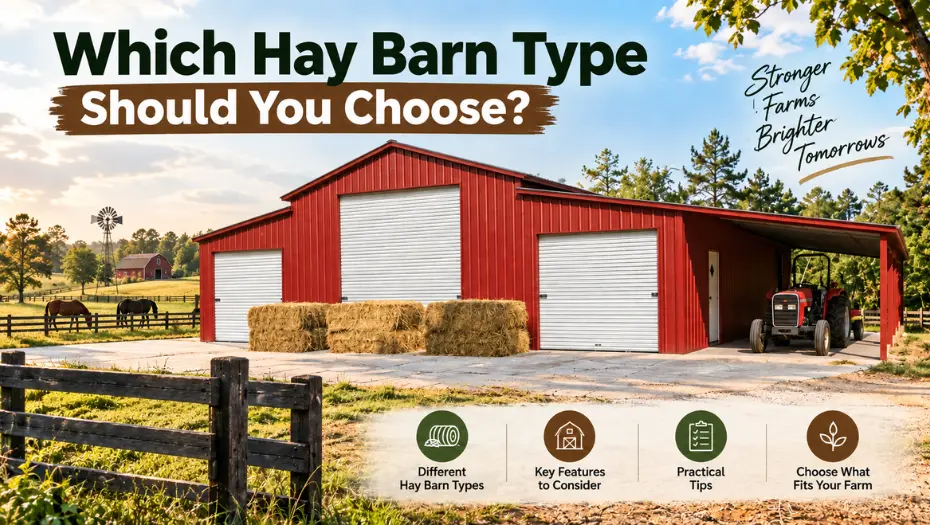
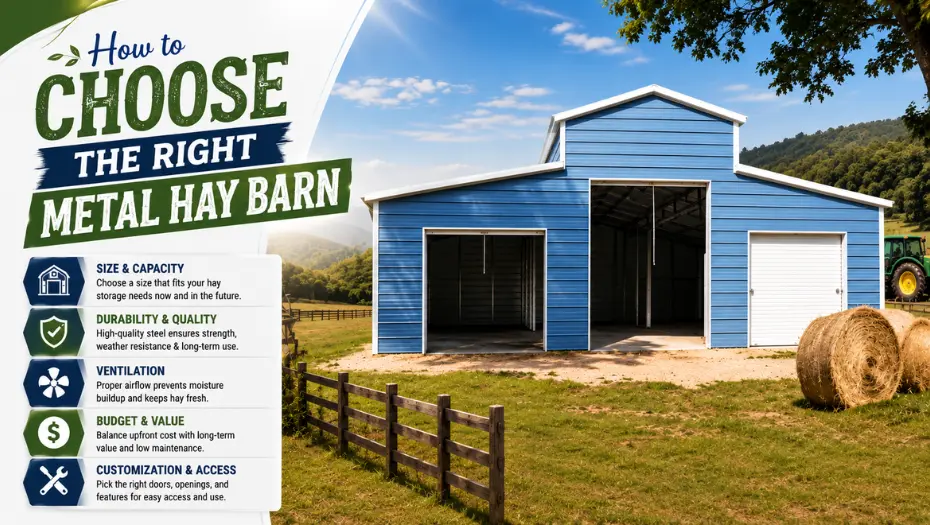
Choosing the right hay barn is about more than picking a size or roof style. The best hay storage building depends on how much hay you store, the type of bales you use, your local climate, equipment access, ventilation needs, available space, and how you plan to use the building in the future.
For most farms, an open-sided or partially open metal hay barn works well when airflow and easy access are priorities, while an enclosed hay storage barn is better when greater protection from rain, snow, moisture, pests, or theft is needed. Raised-center and step-down hay barn designs can be useful when you want hay storage combined with equipment, livestock, or workspace.
This guide explains how to compare hay barn designs and choose a hay storage building that fits your operation.
Before comparing different hay barn types, consider these six factors:
A small farm storing a few dozen bales may have very different requirements from a large hay operation storing hundreds of bales.
The goal isn’t simply to build the biggest hay barn possible. It’s to create enough usable storage space while maintaining practical access, airflow, and protection.
There isn’t one hay barn design that is ideal for every farm. Different configurations solve different storage problems.
| Hay Barn Type | Best For | Main Advantage |
|---|---|---|
| Open-Sided Hay Barn | Hay, equipment and easy-access storage | Excellent natural airflow |
| Fully Enclosed Hay Barn | Long-term protected storage | Greater weather and security protection |
| Step-Down/Raised-Center Barn | Hay, livestock and multipurpose use | Tall center with flexible side areas |
| Metal Barn With Lean-Tos | Hay plus equipment or covered work areas | More usable space around the main building |
| Small Hay Barn | Smaller farms and limited storage needs | Lower footprint and practical capacity |
The right choice ultimately depends on your storage volume, property conditions, climate, and intended use.
An open-sided hay barn is one of the simplest hay storage solutions. It typically has a roof and structural frame with one or more open sides.
This design is particularly useful when natural airflow and quick access are important.
An open-sided hay barn may be a good choice if you:
However, an open design provides less protection from wind-driven rain, snow, and other weather than an enclosed building.
Important: Hay should be sufficiently dry before storage regardless of barn type. A roof alone cannot correct moisture problems caused by improperly cured hay.
A fully enclosed hay storage barn provides walls around the storage area and can include large doors for equipment access.
This configuration makes sense when protecting hay from weather exposure is a major priority.
An enclosed hay storage building can also provide additional protection from unauthorized access, animals, and wind-driven precipitation.
Consider an enclosed hay barn if you:
Ventilation remains important. Enclosing a barn does not mean airflow should be ignored. Proper building orientation, openings, doors, ridge ventilation where applicable, and the overall design should be considered together.
A step-down or raised-center barn has a taller central section with lower side sections. You may also hear this style called a Carolina barn, monitor barn, raised-center barn, or drop-down barn.
This configuration can create separate areas for hay, equipment, livestock supplies, or other agricultural uses.
The raised-center design can also provide opportunities for ventilation through the taller central section, depending on the specific construction and ventilation system.
For farms that want more than a basic hay storage shed, this can be a practical configuration.
Viking Barns’ current 42x30x12 Drop Down Barn is an example of this type of configuration and is listed as a 42 × 30 × 12-foot building.
Lean-tos extend from the sides of a primary barn, creating additional covered space.
This can be useful when you want one building to handle several farm functions.
For example, the center section could be used for protected hay storage while a side lean-to provides space for:
The 48x30x12 Metal Barn Building is one example. Its current configuration includes a fully enclosed 24 × 30 × 12-foot center unit and two 12 × 30 × 9-foot lean-tos.
This type of layout can be especially useful when your hay storage needs are only one part of the overall building requirement.
Roof style matters when selecting a hay storage building.
A vertical roof has panels running from the ridge toward the eaves, creating a configuration designed to help water, snow, and debris move down the roof rather than accumulating along horizontal panel seams.
However, roof style alone does not determine structural performance. Local wind and snow loads, building dimensions, framing, connections, anchoring, foundation, and engineering requirements all matter.
A vertical-roof configuration can be worth considering when your property experiences significant precipitation or when roof drainage and maintenance are important considerations.
For example, the 48x36x12 Vertical Roof Steel Barn provides an enclosed center section with two vertical lean-tos and is designed for storage, equipment, vehicles, and other agricultural uses.
The larger 54x40x12 Vertical Roof Metal Barn adds even more covered space, with a 30 × 40 × 12-foot enclosed center section and two 12 × 40 × 10-foot vertical lean-tos.
Complete Insight: Different Types of Hay Barns and Why Each One Matters
Size should be based on your current hay inventory and expected future needs, not simply the amount of open ground available.
Think about:
For a smaller operation, a small hay barn can be more practical than paying for unused storage capacity.
The 36x30x12 Metal Barn Building, for example, offers a more compact footprint for farms or properties that do not need the capacity of a larger barn.
On the other hand, larger operations may benefit from a wider building that accommodates hay, machinery, and additional agricultural storage under one roof.
Yes.
Round bales generally require more floor area and equipment access for moving, stacking, and retrieving them. Square bales may allow more efficient stacking, but their storage arrangement still needs adequate clearance and airflow.
When planning your hay storage barn, account for:
Don’t calculate storage capacity using floor area alone. The usable storage volume and your handling method are equally important.
Your location should influence the design.
Hot or dry climates
Open or partially open hay barn designs may provide useful natural airflow while keeping hay covered.
Humid climates
Moisture management becomes especially important. An enclosed hay storage building should still be designed with adequate ventilation and access.
Snow-prone areas
Consider the local design snow load, roof configuration, structural engineering, and snow-management requirements rather than assuming one roof style automatically works everywhere.
High-wind areas
The building should be designed for the applicable local wind loads, including appropriate anchoring and foundation requirements.
GEO tip: Building requirements vary by state, county, municipality, and site. Before ordering a hay storage building, check local zoning, permits, setbacks, foundation requirements, and applicable wind or snow-load specifications.
For a small farm, the best option is often a compact hay storage building that provides enough capacity without creating unnecessary unused space.
A small hay barn may be appropriate if you:
A 36x30x12 building can provide a starting point for smaller operations, while a larger configuration with lean-tos can make sense when you need additional covered storage.
The important point is to size the building around your actual operation rather than choosing based solely on appearance.
You Might Like: How to Choose the Right Metal Hay Barn for Your Farm?
Here’s a simple way to narrow down the options:
Choose an open-sided design if airflow and quick access are your biggest priorities.
Choose an enclosed hay storage barn if weather protection and secure storage matter most.
Choose a step-down or raised-center design if you want hay storage combined with other agricultural uses.
Choose a barn with lean-tos if you need hay storage plus equipment or covered work areas.
Choose a small hay barn if you have limited storage requirements or property space.
Consider a vertical roof when roof configuration, precipitation management, and local weather requirements make it appropriate.
Viking Barns offers several configurations that illustrate how different sizes and layouts can serve different agricultural needs:
| Building | Size | Potential Fit |
|---|---|---|
| 36x30x12 Metal Barn Building | 36W × 30L × 12H | Smaller farms and compact agricultural storage |
| 48x30x12 Metal Barn Building | 48W × 30L × 12H | Hay plus equipment or covered storage |
| 48x36x12 Vertical Roof Steel Barn | 48W × 36L × 12H | Larger hay and multipurpose storage |
| 42x30x12 Drop Down Barn | 42W × 30L × 12H | Raised-center/step-down configuration |
| 54x40x12 Vertical Roof Metal Barn | 54W × 40L × 12H | Larger operations needing substantial covered space |
These are examples rather than one-size-fits-all recommendations. Building dimensions, layout, doors, roof style, foundation, and engineering should be selected according to your site and intended use. Current product configurations can also change.
A good hay storage building should provide the right combination of:
Most importantly, dry hay should go into a properly designed storage building. Good barn design helps protect hay, but it cannot replace proper harvesting, curing, moisture management, and storage practices.
You Might Like: Common Mistakes When Choosing a Single Car Garage Size
The right hay barn depends on what you’re storing, how much you’re storing, your climate, your equipment, and how you expect to use the building in the future.
For straightforward covered hay storage, an open-sided design can provide convenient access and natural airflow. For greater weather protection, an enclosed hay storage barn may be more appropriate. If you want hay storage combined with equipment or workspace, a lean-to or raised-center design can provide greater flexibility.
Before choosing a hay storage shed or hay storage building, evaluate your bale volume, handling equipment, local weather conditions, site requirements, and future storage needs.
The best hay barn isn’t necessarily the largest one—it’s the one designed around how your farm actually works.
Expand each item below to explore a few helpful answers before moving to the next blog post.