September 18, 2026



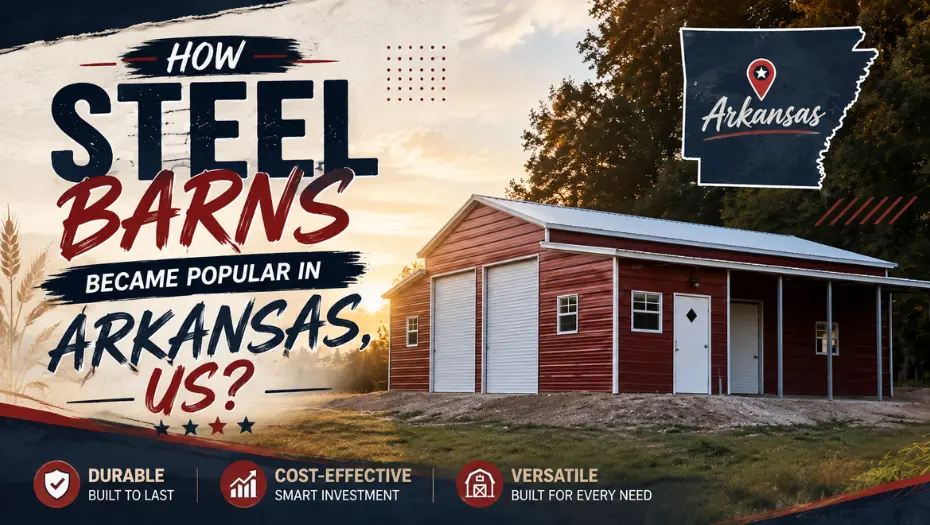
A deep-dive guide to costs, codes, roof styles, and what’s driving the switch from wood to steel across the Natural State.
Drive through Arkansas today, and you will spot them everywhere. Shiny steel roofs sitting behind farmhouses. New barns going up next to old wooden ones that are falling apart. This is not a coincidence. Steel barns in Arkansas have quietly become the top choice for farmers, horse owners, and landowners across the state, and the numbers behind that shift are worth a closer look.
Below is a full breakdown of why this trend is happening, what it costs, which roof style fits which property, and what to check before you sign with a builder.
|
Arkansas Steel Barn Snapshot |
|
|
Ag industry economic impact |
~$19 billion per year |
| State GDP (2022) |
$122.0 billion, still climbing |
|
Design wind speed range |
130 mph – 160+ mph by county |
| Typical install time |
1–5 days for a standard kit |
|
Cost per sq ft (shell only) |
$15 – $45 |
| Realistic steel barn lifespan |
40–60+ years |
|
Energy code in effect |
2018 IECC (Zones 3A & 4A) |
Arkansas is not one climate. It is three, stitched together into a single state, and each one punishes wood-frame barns in a different way.
|
Region |
Main Weather Challenge |
What It Means for a Barn |
|
Central Arkansas |
Severe thunderstorms, tornado corridor | Needs high wind-rated framing and anchored foundations |
| The Delta (East AR) | Heavy rain, soft/clay-rich soil, flooding risk |
Needs corrosion resistance and a foundation built for shifting ground |
|
The Ozarks (NW AR) |
Elevation changes, temperature swings, ice |
Needs snow-load capacity and strong insulation performance |
Wood barns struggle across all three zones. Moisture rots the frame in the Delta. Termites eat through posts anywhere in the state. Storms rip off loose panels in Central Arkansas. A metal barn Arkansas landowner puts up today is engineered to handle whichever of these three challenges shows up on their property.
Steel resists rot, mold, and pests by design, and it also handles wind loads that wood framing cannot match without heavy reinforcement. A well-built metal building in Arkansas comes with an engineer-stamped design that already accounts for local wind speed requirements.
If you are still deciding how to anchor a structure this strong, this guide on the best foundation for a metal horse barn is worth reading before you pick a site, since Delta clay soil and Ozark slopes need very different foundation approaches.
Arkansas is not just a state with lakes and hot springs. It is an agricultural powerhouse, and that economy is a direct driver of barn demand. Agriculture contributes close to $19 billion a year to the state, built on rice, soybeans, poultry, cotton, and timber. Meanwhile, the state’s overall GDP has climbed past $122 billion, with steady population growth adding more rural and semi-rural landowners every year.
This is where steel barns in Arkansas fit right in. A single steel structure can protect tractors, store hay, and shelter cattle, all in one build. Because construction demand is climbing statewide, from Bentonville to Pine Bluff, fast-build steel has an edge over custom wood construction that can take months to complete. Speed matters most during planting and harvest windows, when a delayed barn means exposed equipment and spoiled feed.
Arkansas has adopted wind zone rules based on the 2021 building code, and the required design wind speed depends heavily on your county. Some counties sit in the 130 mph range, while others near tornado corridors are rated for 150 to 160+ mph. Energy performance is governed separately under the 2018 IECC, which places most of the state in climate zones 3A and 4A, meaning insulation requirements differ from a barn built in, say, Texas or Missouri.
Permitting itself is handled at the county or city level, not the state level, so the process is not identical everywhere. Little Rock and Fayetteville both process applications through local planning departments and typically turn around standard permits within one to two weeks. Purely agricultural structures, ones used only for farm equipment, feed, or livestock and not open to the public, may qualify for a reduced permitting path or an agricultural exemption in some counties. That exemption is never automatic, though, so confirm it with your local building office before you break ground.
This sounds like a lot of red tape, but it actually works in favor of steel. Metal framing is naturally suited to hit these wind numbers without major cost increases, while wood framing often needs extra bracing to match the same rating. A metal building in Arkansas built from heavy-gauge steel starts from a stronger base by default. Panel and frame thickness still matter a great deal for how a building performs under pressure, so it helps to understand why steel building gauge matters before you choose a kit.
Roof style is one of the most overlooked decisions buyers make, and it has a direct effect on both price and storm performance.
|
Roof Style |
Panel Direction | Cost | Best For |
| Regular roof | Horizontal, curved sides | Most affordable |
Fair-weather areas, tight budgets |
|
A-frame / boxed eave |
Horizontal, peaked roofline | Mid-range | Rated up to ~140 mph winds; good all-around option |
| Vertical roof | Vertical, ridge to eave | Highest, extra framing |
Heavy rain, snow, and severe storm zones |
For Central Arkansas and the Ozarks, where wind and snow load both come into play, the vertical roof is usually worth the added cost. For Southern and Delta counties with milder wind exposure, a regular or A-frame roof often covers the need at a lower price point.
Cost is usually the first question buyers ask. Here is a detailed breakdown based on current 2026 pricing data for barns and horse barns nationwide, which lines up closely with what Arkansas barn builders typically quote.
|
Barn Type |
Typical Size | Price Range (Installed) | Best For |
| Basic pole/metal barn shell | 30×40 ft | $24,000 – $38,000 |
Hay, equipment storage |
|
Metal horse barn |
20×40 ft | $24,000 – $56,000 | 2–4 stall setups |
| Stepdown/agricultural barn | 42×26 ft | $12,500 – $18,000 |
Livestock, mixed use |
|
Center-aisle horse barn |
Custom | $50 – $120 per sq ft | Boarding, larger operations |
| Commercial-grade barn | Custom | $33,000+ |
Large farms, equipment fleets |
|
Add-On |
Typical Cost | Notes |
| Concrete slab foundation | $4 – $6 per sq ft |
Needed for heavy equipment or horse stalls |
|
Spray foam / batt insulation |
$1.00 – $4.50 per sq ft | Essential for humid summers and cold snaps |
| Tack room build-out | $4,000 – $6,500 |
Climate control protects leather and tack |
|
Security system |
$500 – $1,500 | Common add-on for boarding operations |
| Steel price surcharge | 8% – 15% above base |
Reflects recent tariff-driven material cost increases |
If you want your barn to stay usable through Arkansas’s humid summers and cold snaps, insulation is not optional. This breakdown on the best insulation for commercial metal barns explains what actually performs well in this kind of climate.
Arkansas has a strong horse community, and this is fueling a specific trend. Buyers searching for horse barns for sale in Arkansas want more than a shed. They want ventilation, safe stall layouts, tack storage, and wash areas built into the plan from day one.
|
Horse Type |
Minimum Stall Size |
Recommended Size |
|
Pony / small breed |
8×8 ft | 10×10 ft |
| Average horse (15–16 hands) | 10×10 ft |
12×12 ft |
|
Draft horse / large breed |
12×12 ft | 14×14 ft |
| Foaling stall | 12×12 ft |
14×16 ft |
Metal horse barns cost around $30 to $50 per square foot, noticeably less than timber frame options, which can run $70 to $100 per square foot. Owners also save on upkeep, since steel does not warp, and horses cannot chew through it the way they can with wood trim.
Boarding operations are cashing in on this too. With monthly boarding rates averaging $400 to $800 per stall, a well-built six-stall barn can pay for itself faster than most people expect, especially once maintenance savings are factored in. For owners planning multi-use space, from a tack room to equipment storage, this list of common accessories for a multi-functional steel barn is a solid starting checklist.
Not every barn kit is built the same. When comparing metal barns for sale in Arkansas, run through this checklist before you commit:
If a large upfront payment is not realistic right now, some suppliers offer flexible paths to ownership. A rent-to-own metal barn option can be a practical way to get a structure up now and pay it off over time, without waiting to save the full amount first.
|
Factor |
Wood Barn | Pole Barn |
Steel Barn |
|
Lifespan |
20–30 years | 30–40 years | 40–60+ years |
|
Pest resistance |
Low | Moderate | High (termite-proof) |
| Wind resistance | Needs added bracing | Moderate, post-frame |
Built-in with steel frame |
|
Maintenance |
Frequent repainting, repairs | Periodic post treatment | Minimal upkeep |
| Fire resistance | Low | Low to moderate |
High (Type 1 rated) |
|
Build time |
Weeks to months | 1–2 weeks |
1–5 days |
| Typical cost per sq ft | $20 – $100 | $15 – $45 |
$15 – $45 |
This comparison explains why so many Arkansas landowners are switching, even when replacing a barn that still technically stands.
Not every barn company understands Arkansas conditions. The best Arkansas barn builders know how to design for the Delta’s soft soil, the Ozarks’ elevation shifts, and Central Arkansas’s storm risk, all within the same state. Ask about past projects near your county, and always confirm they follow the latest IBC wind zone standards and current 2018 IECC energy requirements.
It also helps to ask what happens after harvest season. Many Arkansas farms store crops in bulk for months at a time, and a dedicated storage structure keeps grain and hay dry and pest-free year-round. If storage is your main goal, this guide to metal hay barns breaks down sizing and layout options for that exact use case.
The upfront price tag only tells part of the story. Steel’s non-combustible, Type 1 fire rating under the International Building Code often qualifies owners for lower property insurance premiums compared to stick-built structures. Pest resistance also removes a recurring cost: no termite inspections, no chewed trim, no rot repair after a wet Delta spring.
Over a 20-year window, a metal barn Arkansas owner typically spends far less on repainting, structural repairs, and pest treatment than a comparable wood barn owner, even after accounting for the higher initial cost of upgraded insulation or a vertical roof.
Steel barns are not a passing trend in Arkansas. They are a direct response to real problems: three distinct weather zones, rising farm output, strict county-level wind codes, and the need to build fast without sacrificing strength. Whether you are storing hay, housing horses, or protecting equipment, a metal barn Arkansas landowners invest in today is built to outlast the wood barn it replaces, and very likely the one after that.
Think of it as building once and being done with it. No more replacing rotted boards every spring, no more re-shingling after the next big storm rolls through. That is the real appeal here, not just the steel itself, but the years of maintenance and worry it quietly takes off your plate.
Arkansas land tends to stay in the family for generations, and the structures on it should be able to keep up. A barn built right today is one your kids will still be using without ever thinking twice about it.
So if you are still weighing wood against steel, let the weather, the codes, and the math above make the decision easier. The barn you build this year can be the last one this property ever needs.
Expand each item below to explore a few helpful answers before moving to the next blog post.